

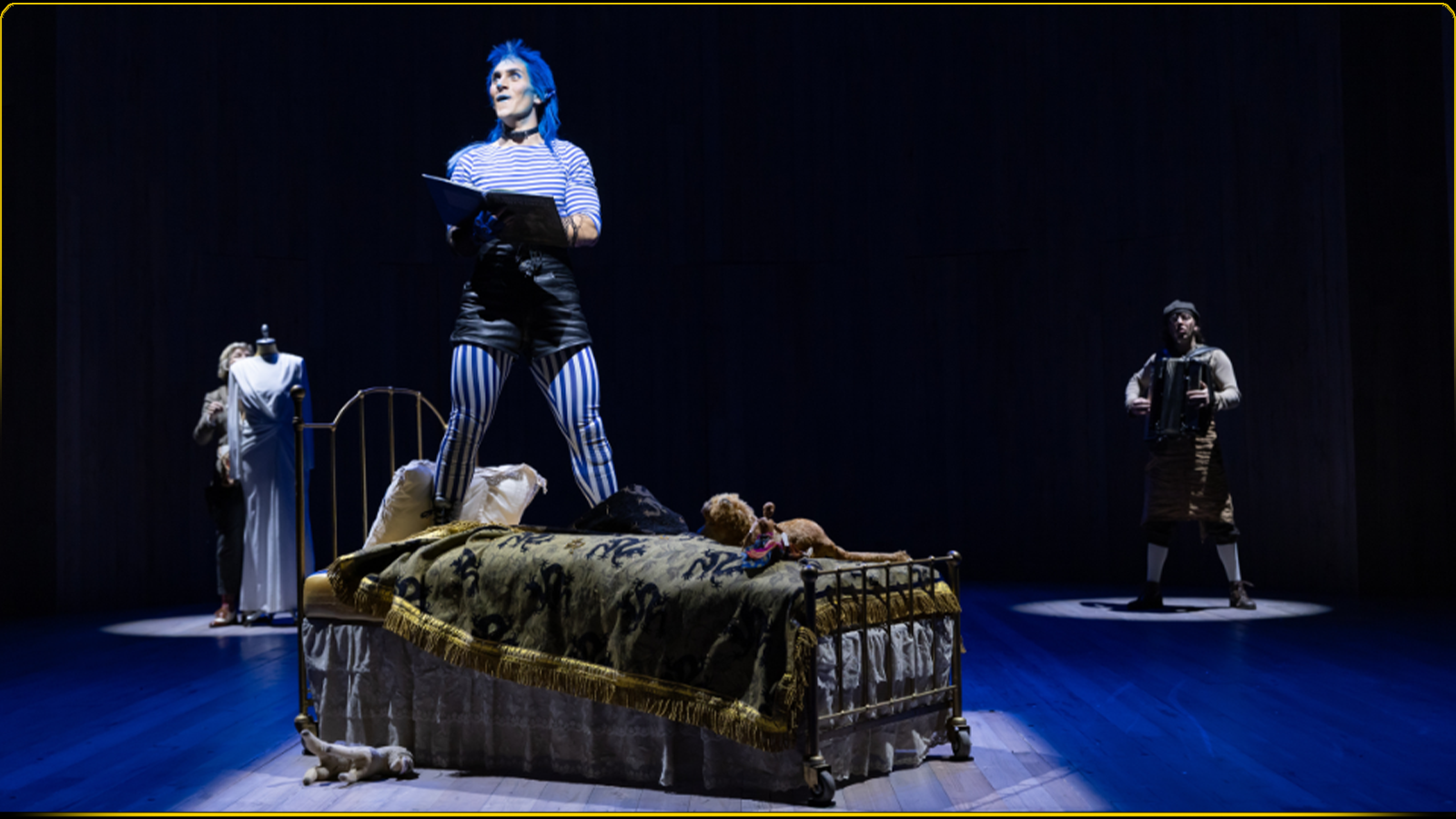
There was a little bed onstage when we walked into Chicago Shakespeare Theater, complete with a fringed bedspread and stuffed animals. It sat there while everyone found their seats. Then came the announcement that the play was about to begin, the blanket moved, and out popped a fairy with pointed ears and a blue rock-and-roll mullet.
Wait. Had somebody been under there the whole time? Did Puck just pull a John Kramer on us? Apparently, watching Saw taught me nothing about checking for someone hiding in plain sight.
It was a wonderful way to catch our attention, and director Edward Hall’s A Midsummer Night’s Dream kept mine from beginning to end. Between the romantic misunderstandings, the acrobatics, and a group of amateur actors whose theatrical ambitions exceed their abilities, this is one of the funniest nights I’ve had at the theater this year.
A forest full of very bad matchmaking
Even if you’ve never seen the play, its romantic complications will feel familiar. Hermia loves Lysander. Demetrius wants Hermia. Helena loves Demetrius. Hermia’s father insists she marry the man he has chosen, and the threat of Athenian law hangs over her refusal. So she and Lysander decide to escape into the woods.
Helena tells Demetrius where they’re going, hoping to win his affection. He follows Hermia. Helena follows him. Everybody is chasing somebody who would really appreciate being left alone.
Enter Oberon, king of the fairies, who instructs his mischievous servant Puck to use a magical flower to help Helena’s situation. Its juice makes a sleeping person fall in love with the first creature they see upon waking. Naturally, Puck enchants the wrong man, and an attempt to straighten things out leaves both men pursuing Helena.
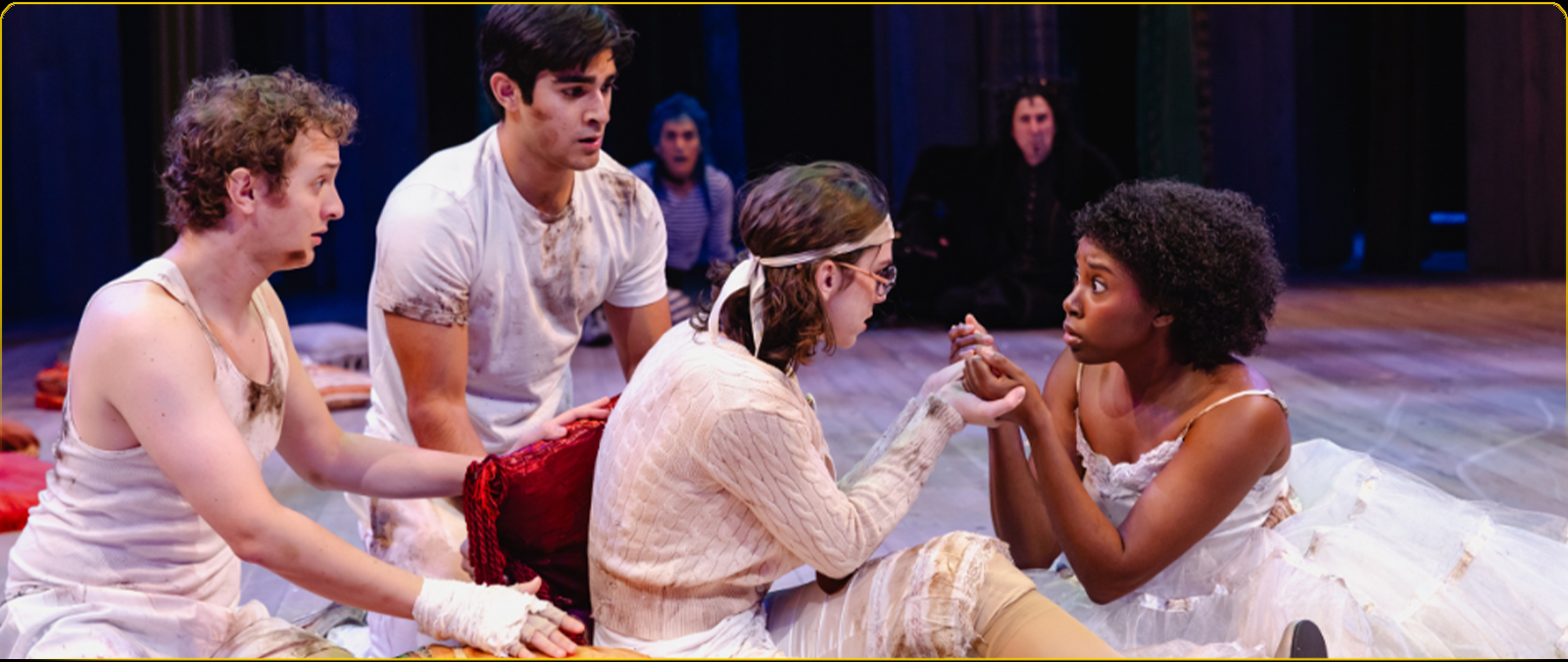
Felicia Oduh’s Hermia, Dan Haller’s Lysander, Esteban Ortiz-Villacorta’s Demetrius, and Grace Steckler’s Helena turn that confusion into an exhausting-looking game of romantic cat and mouse. They run through the audience, climb from balconies, and disappear through the theater entrances. They fall, jump, and carry one another. Their reactions make every new reversal easy to follow, even when the language moves quickly.
By the time the four of them are sitting on the floor in their dirt-streaked clothes, they look like they’ve earned a rest. I was impressed by how much agility and energy the whole production demands.
An almost empty stage with plenty of surprises
If you saw The Winter’s Tale here, you’ll recognize Michael Pavelka’s large checkered wooden wall. This time, the stage remains mostly bare, with plenty of room for the cast to turn the entire theater into their playground.
Pillows fall from above and become beds for whichever character needs to fall asleep next. Titania’s bedding rises through an opening in the floor, while Puck and the other fairies appear and disappear through trapdoors. I kept being surprised by how quickly someone could vanish and turn up somewhere else.
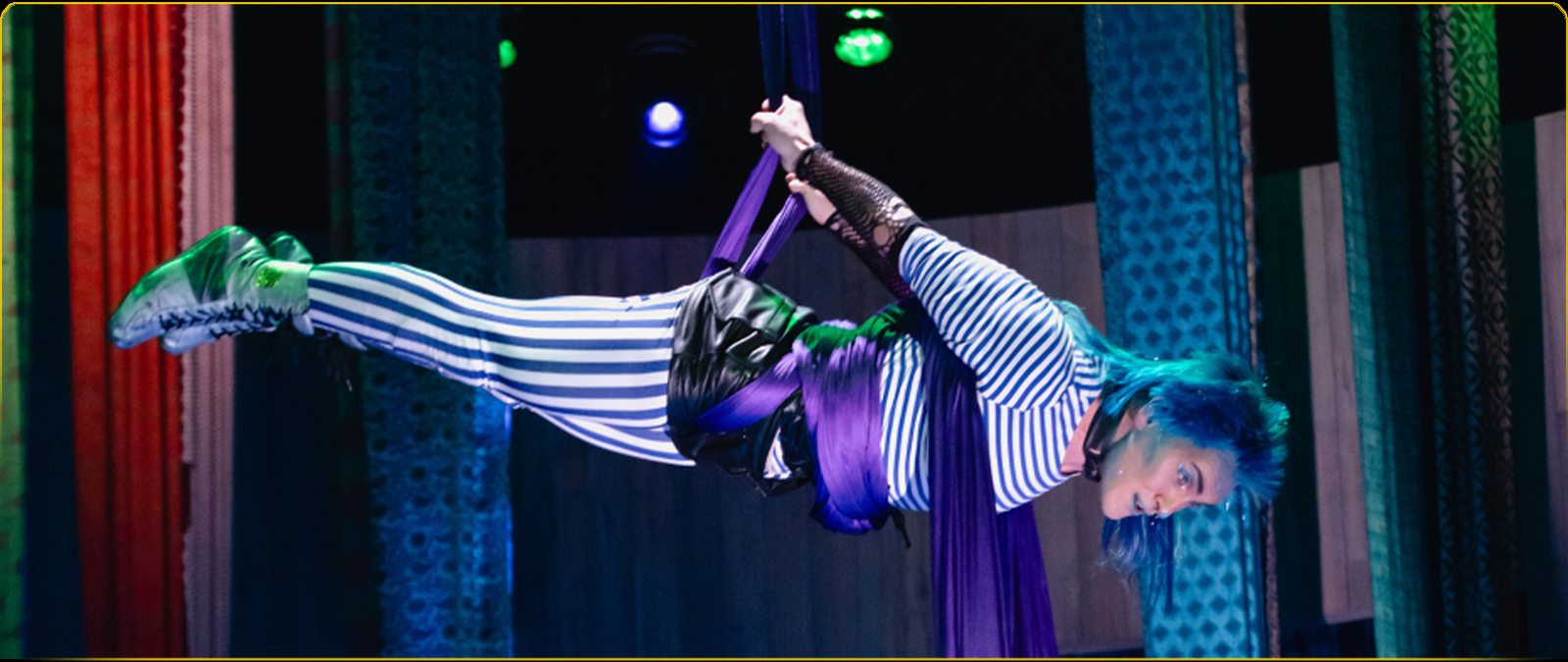
Patty Roache’s Puck is especially hard to take your eyes off. With that blue mullet, striped outfit, and mischievous presence, Roache seems ready to cause trouble anywhere in the room. Then come the aerial silks. Watching Roache suspended above the stage, stretching out horizontally in purple fabric, I found myself thinking about the strength required to make it look so effortless.
Seeing this company perform both repertory productions adds another pleasure. The Winter’s Tale gave the actors moments of silliness, including sheep playing in a band, but it also required them to carry considerable emotional weight. Here, they get to spend an entire evening being playful. Watching Jessica Dean Turner, whose Hermione faced such cruelty in The Winter’s Tale, let loose as the fairy queen is a particular delight.
The company’s transformations are part of the fun. This time, the sheep give way to a fairy court dressed in white, with enormous ruffled collars, little pointed hats, and masks with round black noses. Gathered around their queen, they look like an enchanted troupe of clowns.
Fairy royalty, circus mischief, and hooves for hands
Pavelka’s costumes make the characters look as though they’ve wandered in from different worlds. The amateur theater troupe wears earthy suits, waistcoats, and work clothes, while the young lovers, Theseus, and Hippolyta wear white and cream. The lovers’ coordinated ensembles look ready for a Zara window display.
Oberon and Titania, meanwhile, are pure fantasy. Sean Fortunato’s fairy king cuts a gothic figure in black, with long dark hair and tall boots. Turner’s Titania shimmers in a grand white gown, with long white hair and glittering makeup. Between these two royals, Puck and the clownlike fairies bring the circus.
And then there’s Bottom.
A group of local tradesmen has ventured into the woods to rehearse a play, and Puck transforms one of them into a donkey. Chiké Johnson’s Bottom has fur sprouting through his clothes, hooves for hands, and an enormous donkey mouth lined with oversized teeth. Johnson’s face peeks out through that mouth, so you can still catch his expressions inside the ridiculous disguise.
When an enchanted Titania falls hopelessly in love with him, the sight of this magnificent queen adoring that grinning donkey is enough to get me laughing all over again.
Give the Wall its flowers
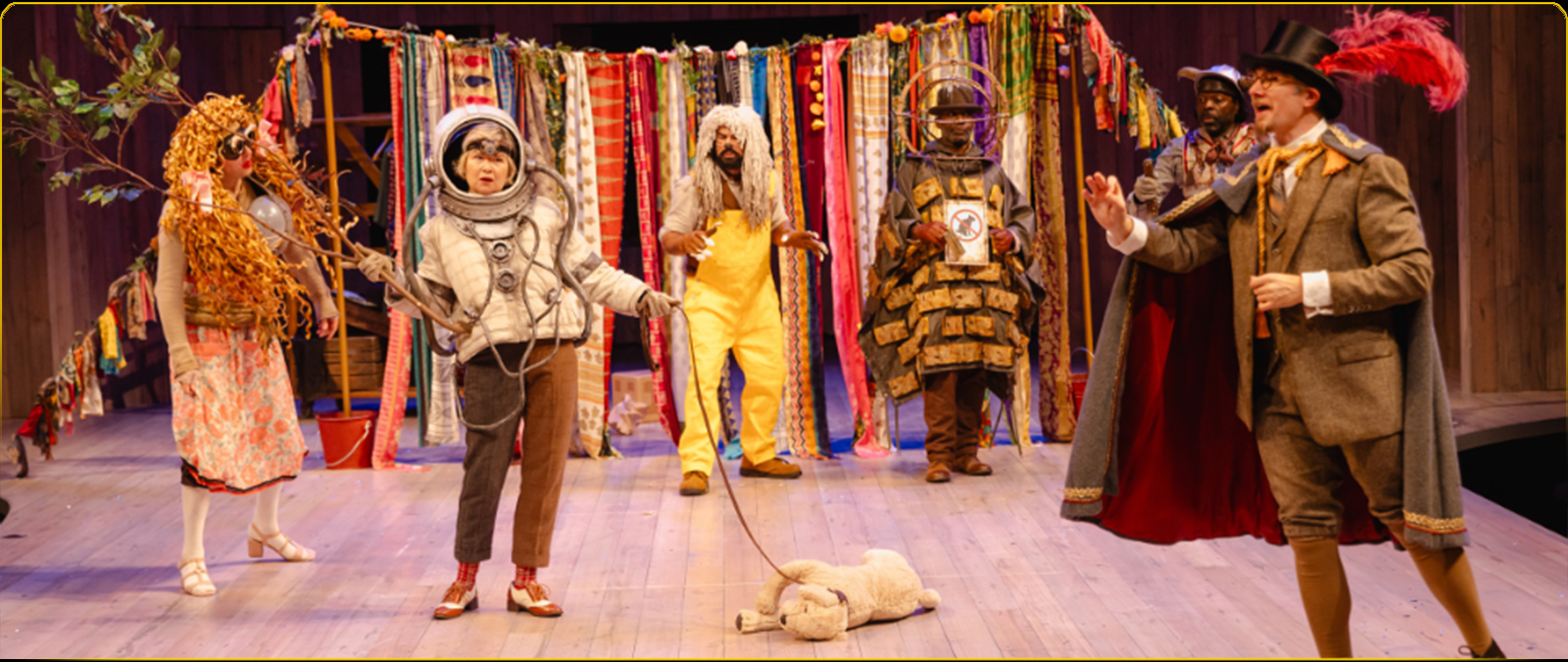
The tradesmen’s eventual performance of Pyramus and Thisbe is a highlight. After watching them rehearse, I thought I knew what I was in for. Then comes an astronaut outfit, a stuffed dog on a leash, and an actor dressed as an actual wall.
Ronald L. Conner’s Wall has bricks attached to his costume and a “no dogs” sign. He treats the assignment with a seriousness that makes it even funnier. Who knew a wall could be such an important character in a love story?
Shakespeare also gets a wonderfully self-aware joke out of Flute, played by Kieran McCabe, objecting to being cast as a woman because he’s growing a beard. Imagine that landing with the original audience, in a theater where the female characters were themselves played by boys or men. The play within the play gives this company room to have a great time with theatrical absurdity.
Having the four lovers, Theseus, and Hippolyta sitting among the audience and commenting on the play was a lovely touch. I was so invested in this ridiculous troupe that I nearly joined in myself. Let them do the play! The Wall has worked very hard for this moment!
A little question after the happy ending
Spoilers for the play’s ending follow.
One thought did follow me out of the theater. Lysander and Titania get their spells lifted, but what about Demetrius?
After watching magically manufactured love become a nightmare in Obsession, I couldn’t help thinking about the man still enchanted at this happy ending. I was delighted for Helena, but somebody should probably check on her husband.
That lingering question gives us something to talk about on the way home. During the performance, I was too busy laughing.
A Midsummer Night’s Dream is a wonderful introduction to Shakespeare. Even when I didn’t catch every word, the actors’ expressions, movements, and reactions kept me with the story. The physical comedy carries so much of the meaning that I was never lost—and I was never bored.
I arrived without having all the characters’ names straight. I left talking about a fairy hiding in a bed, a queen in love with a donkey, and my new favorite wall.
A Midsummer Night’s Dream plays at Chicago Shakespeare Theater on Navy Pier through January 3, 2027. The theater lists a running time of two hours and 15 minutes plus intermission. Tickets and production information. For captioned performances and seating information, consult the theater’s accessibility page.
Special thanks to Zachary Schwartz for his contributions to this review.