


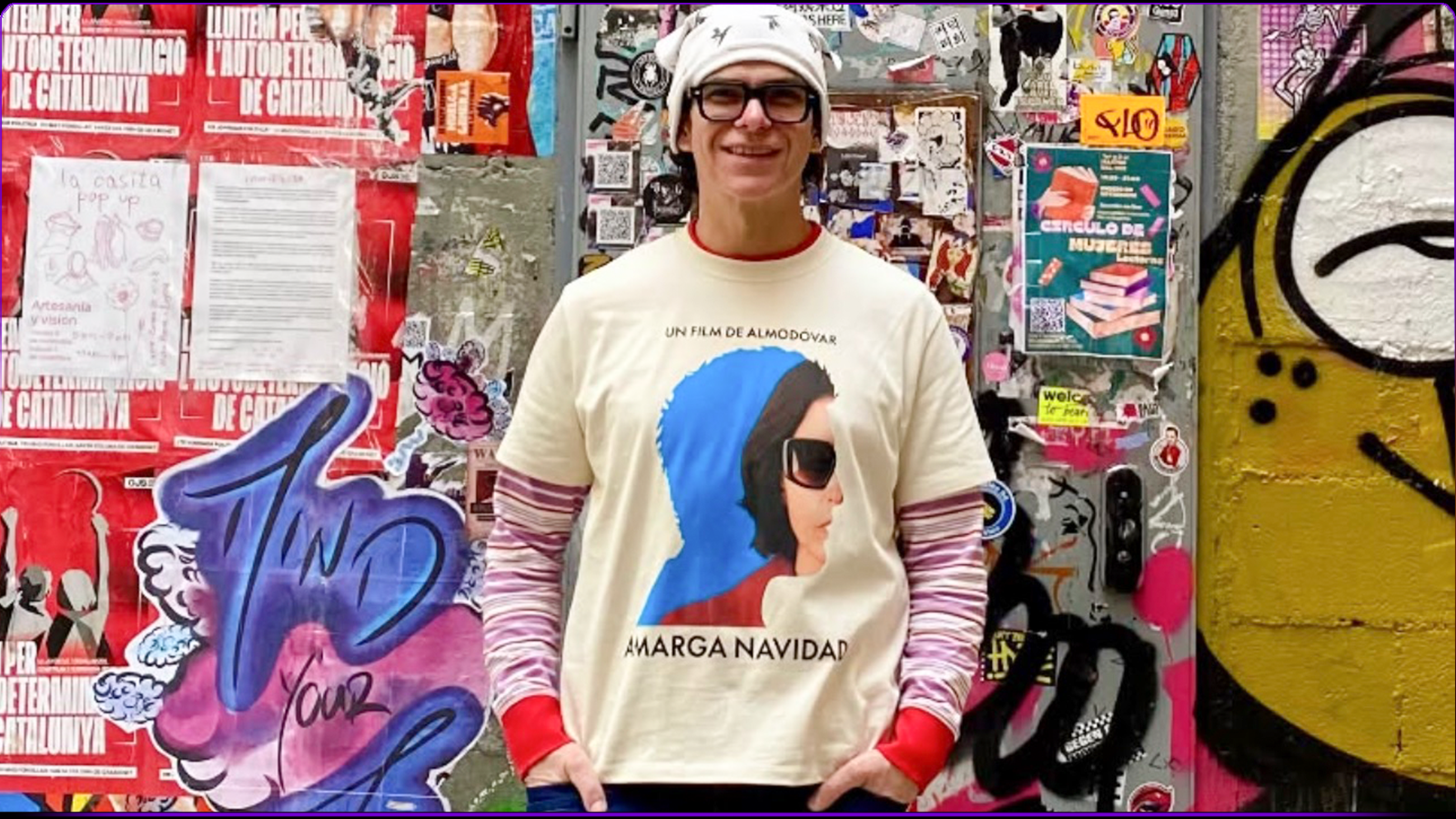
I even bought an Amarga Navidad T-shirt to wear to the cinema. I wanted to look cute and show my devotion. I walked out hating the movie. Months later, giving it another chance changed my mind.
Pedro Almodóvar's new film opened in Spain on March 20, 2026. Around that time, Zara released a capsule collection inspired by it. I browsed the app: there was a tote bag, a sweatshirt and two T-shirt designs. I chose an off-white shirt with the poster printed on the front.
In Barcelona, the advertising was everywhere, from bus stops to train and metro stations. I went that same weekend, hoping to find another of those films that mark a turning point in Almodóvar's career. I wanted another Volver, another What Have I Done to Deserve This?, another Women on the Verge of a Nervous Breakdown.
Instead, I came out saying I had just watched an advertisement for the luxury department store Neiman Marcus. The handbags, clothes and jewelry caught my attention more than the story. Everything seemed perfect, beautiful; the color palette and framing had the finish of a collection of photographs.
The beauty is there. I remember an aerial shot of Elsa, an advertising director played by Bárbara Lennie, and her friend Patricia, played by Victoria Luengo, lying on a black-sand beach. The contrast with their clothes is gorgeous. I also remember Lanzarote's socos, those semicircular stone walls that protect the vines from the wind.
But nostalgia got the better of me. I found flashes of the Almodóvar I missed: Elsa's conversation with the doctor played by Carmen Machi, Bonifacio's striptease, performed by Patrick Criado, and the party thrown by Gabriela, Rossy de Palma's character, where Amaia sings “Las simples cosas,” a song also associated with Chavela Vargas. They were brief moments that gave the heavy drama some breathing room.
A second look
Months later, HolaHello asked me to write a review for the film's arrival in the United States, where it is being released as Bitter Christmas. I said I needed to watch it again: my memory of March was hardly a good one.
I subscribed to Movistar Plus, where it has been available in Spain since July 10, 2026, to revisit it. Then I put on the soundtrack and started writing, looking for inspiration.
This time, I could pay closer attention to what was happening behind those reds, blues and turquoises. I stopped seeing a Neiman Marcus advertisement and began to take an interest in the filmmakers' conflict.
Perhaps it also helped that I had started a narrative-writing course in September at the Escola d'Escriptura of the Ateneu Barcelonès. Writing had interested me for years. Now that I am learning to develop my ideas, I could identify with Raúl, the screenwriter and director played by Leonardo Sbaraglia, who is experiencing a creative crisis despite his prestige.
The film alternates between his story and Elsa's, connecting their worlds through a screenplay in progress. To find inspiration, Raúl turns to the people around him, especially his assistant Mónica, played by Aitana Sánchez-Gijón, and his partner Santi, played by Quim Gutiérrez.
In class, we had discussed the ethics of using other people's experiences to write a story. That question gave me another way into Bitter Christmas. On this second visit, I paid more attention to how easily Raúl turns other people's lives into material for his work, and to the harm he can cause.
I believe in allowing yourself freedom when you write, especially when you are writing for yourself. What we experience, what people tell us and what we observe all feed our ideas. But working with someone else's experiences requires respect. Telling a story can help someone be heard; it can also hurt the people who lived it all over again. What we want to express matters, as does how we do it.
A similar discussion arose around ViX's Timbiriche series. In a statement issued before its premiere, Alix Bauer, Diego Schoening, Mariana Garza, Erik Rubín, Benny Ibarra and Sasha Sokol said they had neither participated in its creation nor been consulted about the stories it tells. They added that, as of that statement, they had not even been invited to watch it. The dispute highlights the distance between the person who turns a life into fiction and the person who has to see themselves represented in it.
In Bitter Christmas, that tension comes through in the arguments between Raúl and Mónica. I find Sbaraglia and Sánchez-Gijón's performances masterful. Their confrontations are uncomfortable because of what is at stake between them, beyond the screenplay. These were among the moments I appreciated most on a second viewing.
Three stars and a recommendation
The predominance of conversations in interiors and an almost episodic structure give the film a small scale. The spaces are carefully considered down to the last color, but the storytelling does not always achieve the emotional intensity it promises. The beauty of the rooms ends up attracting more attention than what happens inside them.
The different layers of fiction also return to the same question: how far can a creator go in appropriating someone else's life? The stories mirror one another, although their parallels sometimes repeat the conflict instead of deepening it. The device becomes more insistent than revealing.
That insistence has an emotional cost. As the film emphasizes the construction of the screenplay, Elsa's relationships lose their independence and begin to feel like pieces serving another creator's story. Interest in her emotional connections gives way to an explanation of the artifice. The result is a good film, though a lesser Almodóvar.
My favorite Almodóvar films remain others. The second time, I appreciated Bitter Christmas much more, especially its reflection on writing and its lead performances, although my enthusiasm never reached the level of those films I had hoped to rediscover in March. I give it three stars out of five.
I recommend it above all to people who follow Almodóvar's work. Watching it again helped me, with different expectations and at a different moment in my life. I appreciated his search for new stories while retaining his own aesthetic. His portrait of a creator trying to move forward also connected with my desire to write.
And despite the title, I would not recommend it as a Christmas movie in the usual sense. Elsa's story takes place over a holiday weekend in early December 2004, with Christmas approaching. The title refers to José Alfredo Jiménez's song “Amarga Navidad,” which we hear performed by Chavela Vargas.
One idea from Elsa and Patricia's conversation stayed with me: a story can lead to an ending its author had not imagined. Something similar happened with this review. I began with the memory of a disappointment and ended up finding reasons to appreciate the film.