
I really wanted to like The Cat in the Hat. I went in excited. I love seeing Dr. Seuss’s impossible shapes and strange creatures brought to life through animation, where gravity can take the afternoon off and the imagination can go places live action can’t.
But almost as soon as the movie started, that excitement began to fade. What I wanted was a family adventure I could get swept up in alongside its youngest viewers. Too often, I felt like the accompanying adult, waiting for the film to offer me something to enjoy with them.
The story follows Gabby and her younger brother, Sebastian, who have moved to a new town because of their mother’s work. The Cat arrives to help them adjust, setting off an adventure through worlds inside the family’s moving boxes. It’s a promising way to turn the belongings they’ve packed into possibilities for something new.
My first obstacle, though, was the look. The human adults reminded me of the characters in those mysterious animated movies you’d find in Walmart’s $3 DVD bin. The children fare better, but their designs still feel surprisingly basic for a film drawing on Dr. Seuss.
The hair, to be fair, deserves its flowers. The curls and sculpted shapes have character. But the skin and much of the clothing have a smooth, plasticky finish that reminds me of older 3D-animated movies. A still frame can look cute; watching the characters move, I kept getting an unfinished feeling.
That impression is strongest in the real-world scenes, where even the cardboard boxes look oddly plastic. The apartment reminded me of a room I built in Maya for animation class. I wasn’t expecting my homework to follow me to the movies.
The worlds inside the boxes are more appealing. Some backgrounds are lovely, and belongings becoming living creatures—including Sebastian’s underwear swimming around like little manta rays—is exactly the sort of ridiculous invention I wanted. A later monster design is particularly striking, too.
Still, I often felt the lighting was doing much of the work. Rich colors and dramatic glows create atmosphere while many of the surfaces remain too simple. I understand the illustrated look the film is reaching for. Spider-Man: Into the Spider-Verse shows how exciting it can be to make animation feel like a comic book coming to life. Here, the execution too often felt underdeveloped to me. By the time the more imaginative environments arrived, I was already disconnected. I could admire individual images without being pulled back into the adventure.
Gabby’s story had a similar problem holding my attention. Moving is a perfectly valid reason for a child to be upset: it means leaving behind friendships, routines, and a sense of control. Inside Out builds its emotional world around Riley’s move for her father’s job, while Spirited Away also begins with a girl unhappy about moving. Familiar material can still make for a powerful story.
Here, I understood Gabby’s situation more than I connected with her. She spends so much of the film complaining and directing her frustration at her mother that she comes across as bratty. The writing gives us too few glimpses of warmth or affection to balance that resentment. After a while, her unhappiness starts to feel stuck on the same note. I wanted to know her beyond her objections to everything around her.
One quieter mother-daughter moment did reach me, touching on how little children can know about their parents’ interests and capacity for fun. There’s something quietly sad in that idea. I wanted more of the warmth and understanding the film finds between them there.
I was also happy to see a Latino family at the center of the story, voiced by America Ferrera, Xochitl Gomez, and Tiago Martinez. I just wished their identity felt more present in their everyday lives. Latino families can speak English, and there’s no single way we have to behave, but a few culturally specific details could have made this family feel more distinct. Even an exasperated “este gato está loco” would have given me a moment of recognition—and been a reasonable assessment of their visitor.
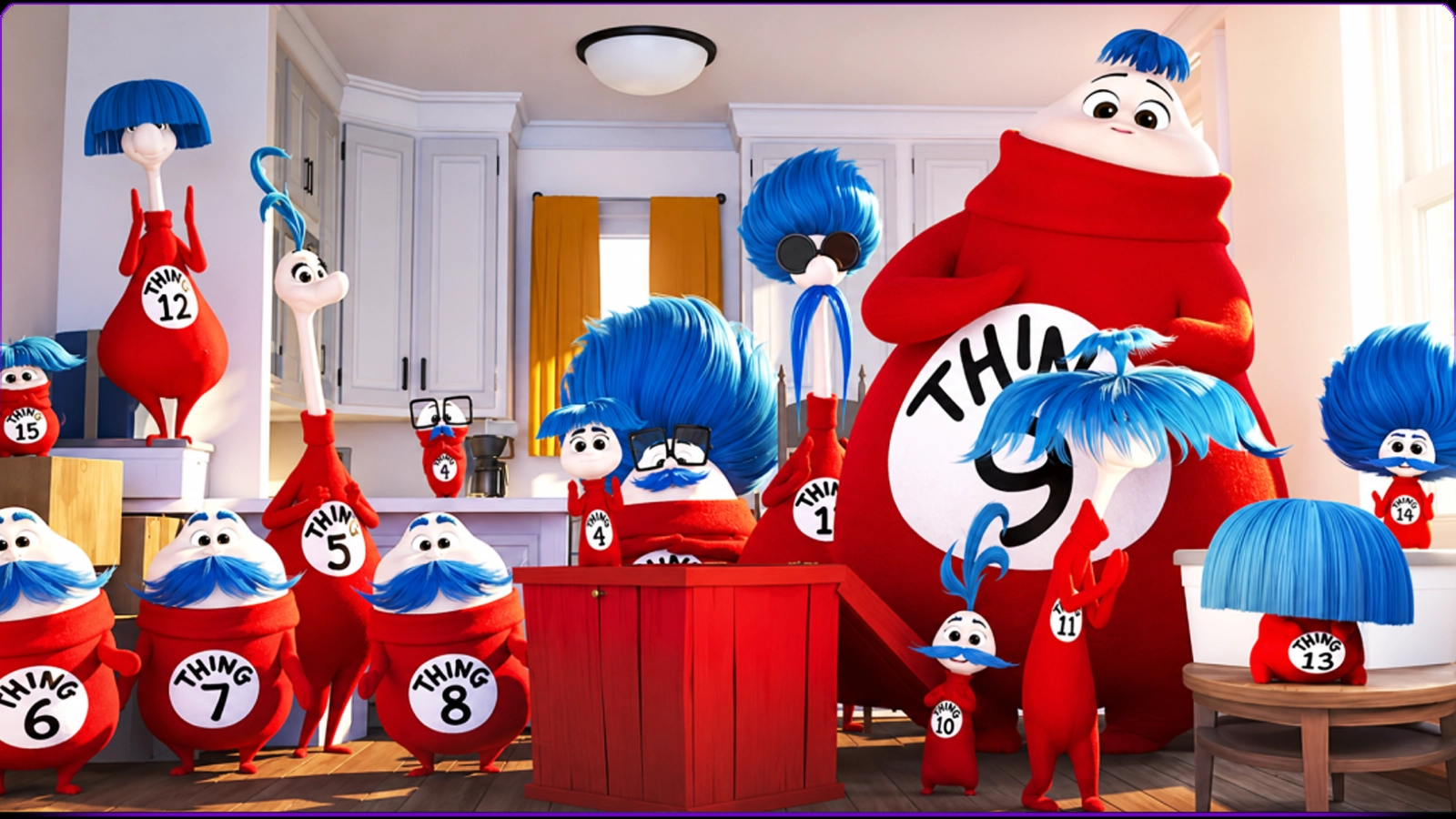
My favorite company, though, was Sebastian, Waffles the fish, and the Things. The Things are adorable, whimsical creatures in so many different shapes, and I loved meeting a whole crowd of them. Their appeal was more “aww, look at them” than nonstop hilarity, but their wordless physical comedy made Sebastian’s and Waffles’s reactions funnier. When Gabby and the Cat headed off together, I kept thinking: can we go back to the others, please? I wanted more of the Things’ world, their relationships, and their history.
As for the Cat, I liked him. I think.
Bill Hader’s version is less overwhelming than Mike Myers’s live-action incarnation, but I missed a stronger sense of unpredictable mischief. He’s energetic without feeling particularly unhinged. Giving him job-related stakes offers some comic potential, yet it also weighs him down. Apparently, even the Cat in the Hat has to worry about his next performance review.
He also seems to work in franchise development. He jokes about the Things getting their own spin-off, and his sequel talk during the credits landed more like an appeal for support than an enticing promise of another adventure. Darling, let us finish this one first. Those jokes pulled me out of the fantasy just when I wanted the movie to make its own world worth staying in.
I did laugh, and I had fun in stretches, even if no particular joke stayed with me afterward. There are appealing creatures, imaginative touches, and a cast full of people I love. But the emotional resolution makes sense without carrying much weight, and those scattered pleasures never came together into a satisfying whole.
That is my biggest disappointment: a family movie should offer something for the people bringing the children, too. With something like PAW Patrol, I go in expecting a film aimed squarely at very young kids. A Dr. Seuss adventure carries a different promise for me. Family films have shown us time and again how humor, imagination, and emotion can reach children and adults together. The grown-ups buying the tickets deserve more to do than wait for the credits.
Hearing the children around me laughing and clapping was lovely. I just wish I’d been laughing with them more often.